Aïda
CASE STUDY • Data Analytics • July 2026

Chinook Data Analysis

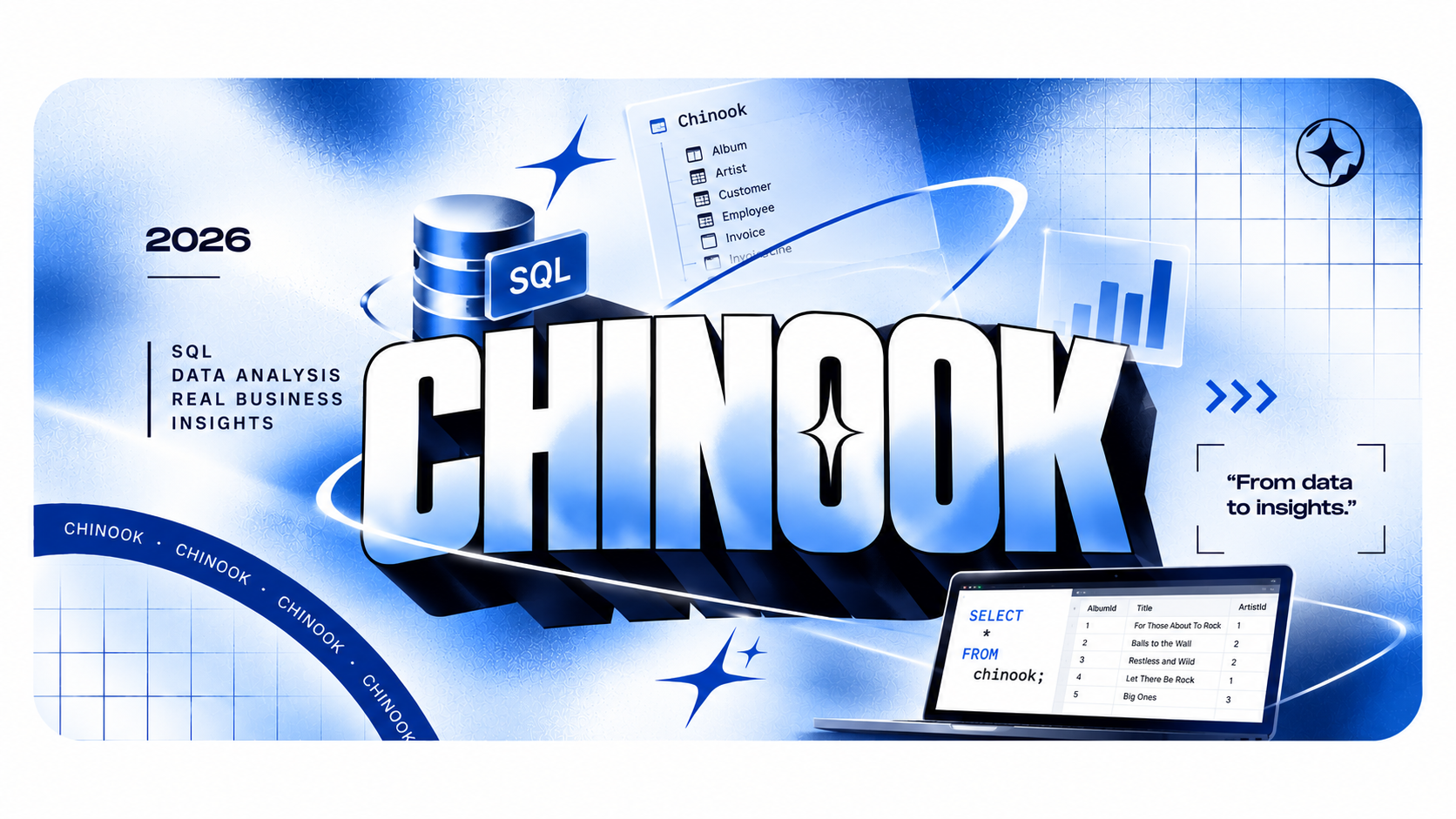
An independent relational SQL analysis querying the Chinook music-store database to investigate sales patterns across customers, invoices, and catalog data.

SQLMySQL WorkbenchRelational Database Querying
SQL Analysis Chinook Relational SQL Analysis
TARGET USERS & AUDIENCE

Business analysts, store managers, and decision-makers seeking quantitative evidence from relational database transactions.

THE PROBLEM

Understanding business dynamics across an e-commerce music store requires querying relational schemas to evaluate purchasing trends, invoice distributions, and employee sales patterns.

MY ROLE

I used MySQL Workbench to query related tables, with filtering, grouping, joins, aggregations, and subqueries, focusing on converting business questions into queries and interpreting returned data.

WHAT WAS DESIGNED & BUILT

A comprehensive SQL analysis querying related tables in MySQL Workbench to answer key business questions regarding invoice patterns, customer purchases, and catalog metrics.

OUTCOMES & RECOGNITION

SQL Analysis — Successfully converted key business questions into multi-table SQL queries.

METHODS & TOOLS
SQLMySQL WorkbenchRelational Database Querying
01 // CONTEXT

Overview

An independent SQL analysis of the Chinook sample music-store database, exploring business questions about sales and purchasing patterns across customers, invoices, tracks, artists, genres, and employees.

Core Objective: Delivering a functional, high-value solution addressing verified real-world needs at Livingstone College and beyond.
02 // THE CHALLENGE

Problem Statement

Understanding business dynamics across an e-commerce music store requires querying relational schemas to evaluate purchasing trends, invoice distributions, and employee sales patterns.

Affected Stakeholders

Business analysts, store managers, and decision-makers seeking quantitative evidence from relational database transactions.

03 // OWNERSHIP

My Role & Responsibility

I used MySQL Workbench to query related tables, with filtering, grouping, joins, aggregations, and subqueries, focusing on converting business questions into queries and interpreting returned data.

Key Competencies Demonstrated: Problem Discovery, User-Centered Design, Technical Execution, and Rapid MVP Delivery.
04 // METHODOLOGY

Process & Execution

1

Explored the Chinook relational database schema and table relationships in MySQL Workbench.

2

Formulated SQL queries to investigate sales and purchasing patterns.

3

Utilized filtering, grouping, joins, aggregations, and subqueries to query related tables.

4

Executed queries and inspected returned data rows for consistency and relational integrity.

5

Interpreted the query results to extract clear, data-backed business insights.

05 // DELIVERABLE

Solution & Core Features

A comprehensive SQL analysis querying related tables in MySQL Workbench to answer key business questions regarding invoice patterns, customer purchases, and catalog metrics.

Applied Technologies & Methods
SQLMySQL WorkbenchRelational Database Querying
Interface Specification: SQL query code snippets and resulting query output tables in MySQL Workbench.
06 // IMPACT & REFLECTION

Results & Learnings

Successfully converted key business questions into multi-table SQL queries.

Queried relational tables using joins, groupings, aggregations, and subqueries in MySQL Workbench.

Interpreted query results to provide clear evidence on purchasing and sales patterns.

KEY TAKEAWAYS & LESSONS LEARNED

"How to query multi-table relational databases in MySQL Workbench, translate business inquiries into SQL, and interpret returned data accurately."

NEXT CASE STUDY • AI Product Builder

Digital Timesheet System

Back to All Projects Next Project